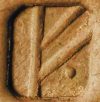

Runic inscriptions in Anglian and Saxon pottery are quite uncommon, but several 5th century urns were found in the cemetery at Spong Hill in North Elmham, Norfolk, bearing similar stamps comprised of three runes. They are stamped upside down on the exemplar, but the letters are Elder Futhark mirror runes (mirrored across the vertical axis). The runes Ansuz, Laguz, and Uruz appear together on contemporary Scandinavian finds as well, including runestones, bracteates, and amulets. Scholars cannot agree on the meaning, and theorize that it may be a symbolic inscription having charm-like properties – or may simply be the word for “ale.”

As usual, this stamp is cut from a piece of antler and just a sharp blade was enough to do the trick. Ah, the joys of an alphabet comprised of straight lines. I intend to make a couple of urns and will have to see whether they confer magical protection or simply hold my beer.

UPDATE:
I’m always too impatient to wait until I’ve had a chance to go make a pot and I’m sure it is not as interesting to just keep seeing test impressions on kneadable eraser, so I’ve decided to go through some old posts and edit them to add images of the finished pots. Here’s the first of the Magic Ale Urns. I’m looking forward to drinking out of it once it is fired…for Science, of course.

Further reading:
HINES, JOHN. “Grave Finds with Runic Inscriptions from Great Britain”. Runeninschriften als Quellen interdisziplinärer Forschung: Abhandlungen des Vierten Internationalen Symposiums über Runen und Runeninschriften in Göttingen vom 4.-9. August 1995 / Proceedings of the Fourth International Symposium on Runes and Runic Inscriptions in Göttingen, 4-9 August 1995, edited by Klaus Düwel, Berlin, Boston: De Gruyter, 2012, pp. 186-196. https://doi.org/10.1515/9783110821901.186
 farolfvs me fecit