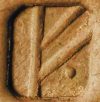
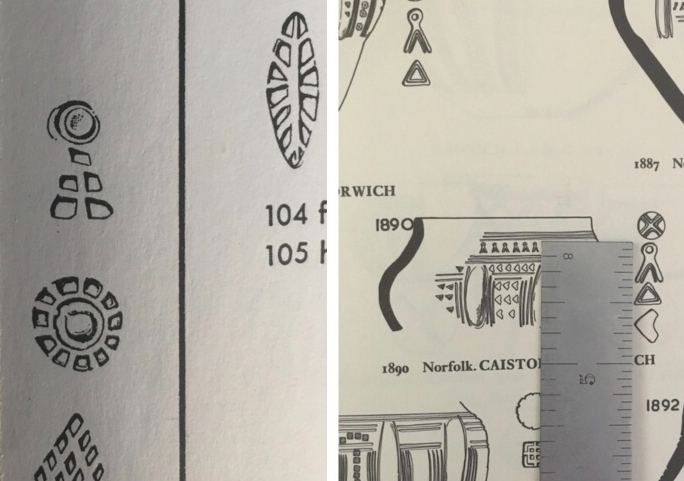
I got started with stamped pottery via an interest in Langobardic pottery styles, but once I began to branch out into the styles associated with insular Saxon and Anglian pottery traditions from the same time period, I started seeing a lot of similar general shapes and motifs. The gridded diamonds, for example, or some of the horseshoe shapes. There’s also a sort of keyhole shape (perhaps meant to represent a cicada or a bee, as seen in contemporary jewelry?) that appears in several forms on East Anglian pots and at least one example of the same silhouette on a pot from Inveruno, Italy (just west of Milan). Just for fun, I decided to replicate both of them.
The smaller of the two is based on an example from Caistor-by-Norwich, where a potter was active around the middle of the 6th century CE and several surviving examples of their work bear this stamp (see Myres, p.42). The larger one is the Inveruno stamp, found on a large flask now in the collection of the Museo Civico in Legnano (see von Hessen, p.11). Both of my dies are cut from antler, and consist of a triangular shape with a ring at the top. I bored the holes out with the bow drill and then carved in around it with a sharp blade. The Caistor-by-Norwich stamp is about 5/16″ tall, and the Inveruno stamp is a bit over 1/2.”
So here they are, the Langobardic and East Anglian takes on a similar shape:

Sources:
- Myres, A Corpus of Anglo-Saxon Pottery of the Pagan Period, Vol. 1, p.42; Vol. 2, Fig. 259.
- Otto von Hessen, Die langobardische Keramik aus Italien, p.11, pl. 4.
 farolfvs me fecit