

Overview
For a comparatively quick shoe-making project, here are some examples of one-piece shoes from bogs in what is now northern Germany dated between the 1st and 4th century CE. Scroll to the bottom for links to downloadable PDFs of cutting patterns. These require a minimal amount of stitching, no last, and no special tools beyond a sharp knife, awl, needles and thread.
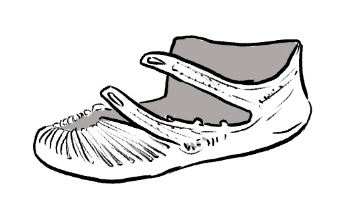

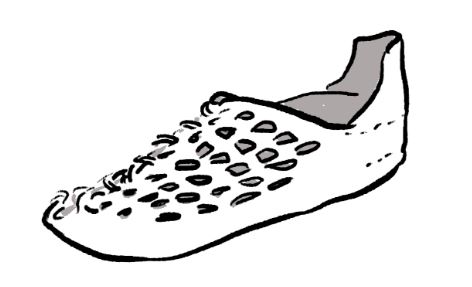

What are these shoes?
We don’t know what the period term for these was, but today they’re sometimes referred using the Latin term for the comparable Roman style known as “carbatinae.” Some examples, particularly those associated with Germanic-speaking groups from beyond the Roman frontier, are asymmetrical with the laces closer to inside edge of the foot rather than straight down the middle. For comparison, you can take a look at a pair of the symmetrical Roman type found with a group of 4th century CE items deposited in a bog in Deurne, Netherlands (click here – see p. 310) .
Versions may be appropriate for a wide range of European Iron Age presentations. Although I’ve referenced extant examples from the 1st through 4th century CE, there are much older, similar finds as well. And while Penelope Walton Rogers also suggests the one-piece shoe as a “credible model” for an Anglo-Saxon shoe prior to the late 6th century, they seem to disappear from the archaeological record around 600 CE.
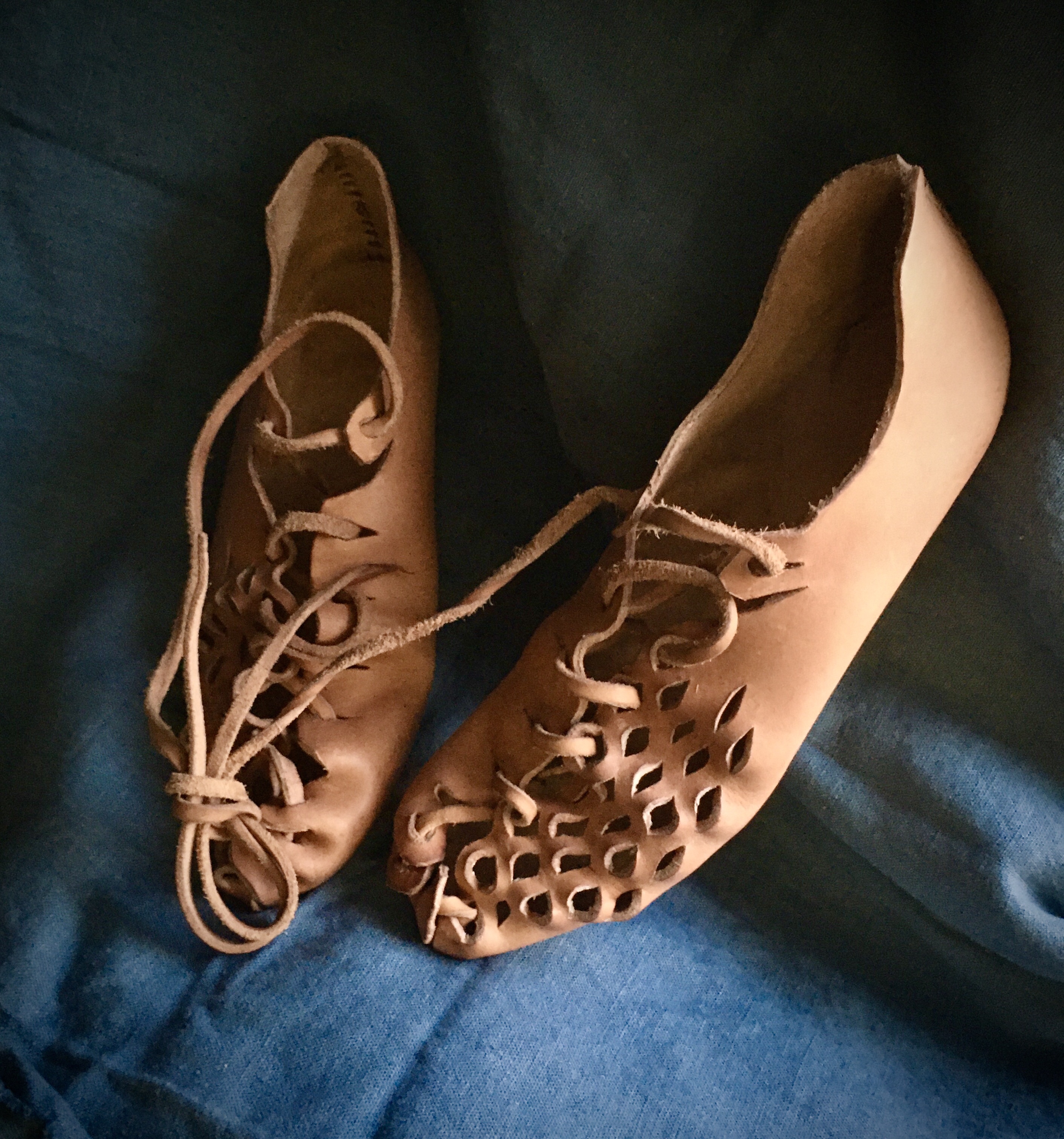
Margrethe Hald’s book Primitive Shoes has a chapter on this type with many extant examples excavated on the Jutland Peninsula. Although the designs all vary slightly, there are two general kinds that turn up – some have a toe area created by overlapping “petals” strung on a thong to draw them together. Others have a series of slits cut on one side so that the lateral side of the shoe expands in a stretchy net to shape it to the foot.
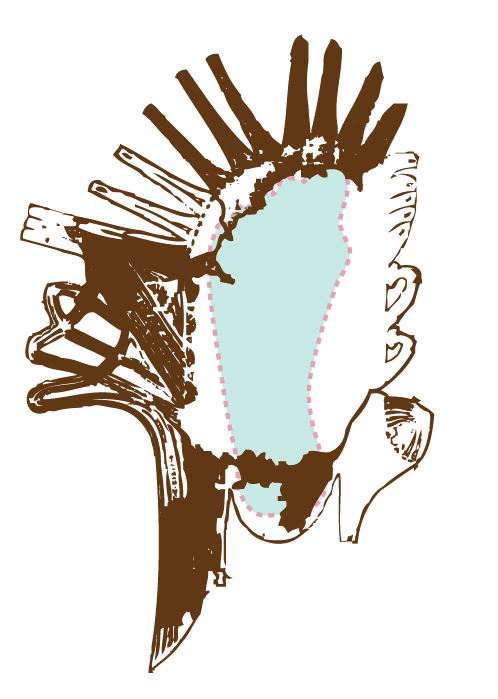
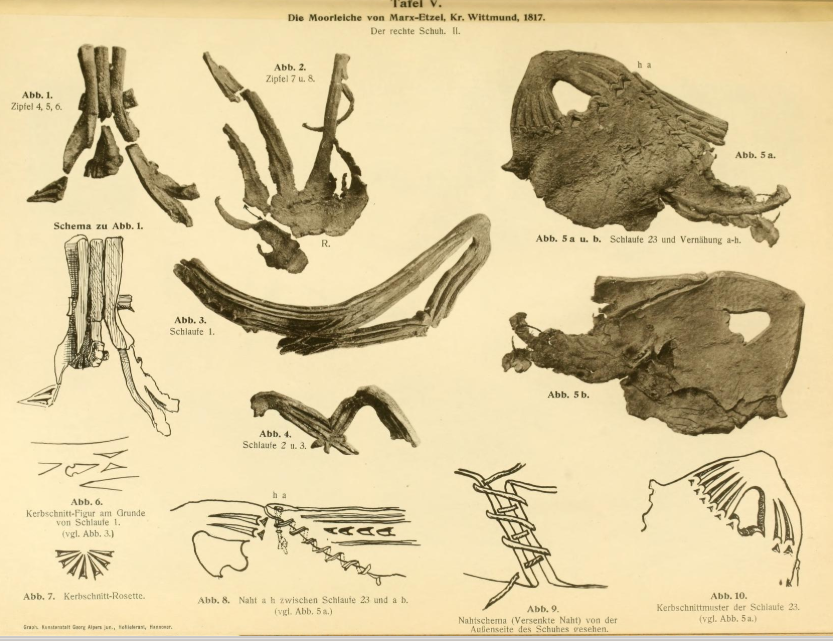
An example of the first type with the “petal” toe is shown below. Dated to the 1st or early 2nd century CE, the Marx-Etzel shoe was found in a bog in northern Germany in 1817 and published in 1907 (click here for the original publication). The images from that publication show the decorative details and stitching techniques (see pages at right), and I’ve enlarged the diagram to show the cutting pattern as well. Similar shoes show up in many other locations in northern Germany and Denmark in the early centuries of the first millennium CE. The body of a man who died between 260 and 380 CE in Obenaltendorf (Lower Saxony) was wearing a very similar pair (image at the bottom).




A pair of the second, net-like type from the mid-4th century CE was excavated at a late Roman site in Cuijk, Netherlands (see Page 140 here). According to Carol van Driel-Murray, these shoes may reflect the cultural preferences of the Germanic soldiers serving in the Roman army at the time. Primitive Shoes also includes a pair like this found at Damendorf (see p.54), which are dated somewhat earlier than the Cuijk shoe.


To learn more about the distribution of one-piece shoes during the Roman Iron Age, take a look at this interactive map I put together (the red dots show finds from this period). The map shows examples from sites within and beyond the Roman Empire, and clicking on a find site will show you a sketch of the shoe style and provide an estimated date.
If you are interested in more historical examples, I recommend Marquita Volken’s book Archaeological Footwear. which provides lots of great context for where and when these shoes were in use. The book Lederfunde der Vorrömischen Eisenzeit und Römischen Kaiserzeit aus Nordwestdeutschland by Julia Gräf also includes scale drawings of archaeological examples of both types, including the Damendorf net-shoes and several beautifully decorated petal-style shoes.
Patterns
Click here to download pdfs of the patterns I used to make both types of shoe – you may need to fiddle with printer settings to scale them up or down to fit your feet, or use them as a basis to sketch your own custom pattern. I highly recommend making a test shoe using paper covered in duct tape – it will behave enough like leather and will let you work out any needed adjustments before cutting into the good stuff.
Further reading:
Primitive Shoes: An Archaeological-Ethnographical Study Based Upon Shoe Finds from the Jutland Peninsula, Margrethe Hald
This study looks at a relatively finite geographical area in northern Europe where bogs have preserved a large number of shoes from many different time periods. The work includes one-piece shoes and turnshoes and has examples with cutting diagrams that are of interest to anyone looking at footwear from the late Iron Age through the Viking era.
Archaeological Footwear, Marquita Volken
In this excellent resource, the author presents cutting patterns and construction methods for a wide range of historical European shoes from prehistory through the 17th century.
Res Rarae – this artisan’s site includes reconstructions of several of the shoes discussed in Hald’s book; look under the 3rd and 4th Century CE headings
 farolfvs me fecit