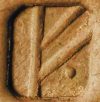

Since it has been over two years since I first published my 9th c. Frisian kit, I thought it was time for a follow-up to include a few more items I made to help flesh out the presentation. I did not base this kit on a single grave find, so I cannot say for certain that one person might have owned every single one of these items, but the goal was to personalize the ensemble a little more. For the most part, these are accessories based on Frisian finds from the same time period as the rest of the kit. Over the last year or so, I have made a couple of bone items, a pair of tweezers, a clay cup, a knife sheath, a small purse, a less-fancy belt, and a spare tunic, all of which help to make the ensemble feel more like an actual person’s possessions.

There are two other items that I sometimes add to this kit but did not include in this post: the Westerklief arm-ring (too high-status) and the Hedeby vest (a distinctive item not documented in a Frisian context). Both of these will get their own posts. My first foray into Frisian woodwind instruments is already posted here. Unfortunately, I don’t usually remember to take photos of myself at events, so the two photos at left are all I have to show the current state of the ensemble.
For the second tunic, I used the exact same cut and construction as the first one, and selected an 11×9 threads/cm wool twill in a pale blue-gray desaturated woad tone. I felt this was in keeping with my previous decisions about limiting my color palette to natural wool shades and partially-exhausted dye baths rather than first/multiple dips.
Tweezers
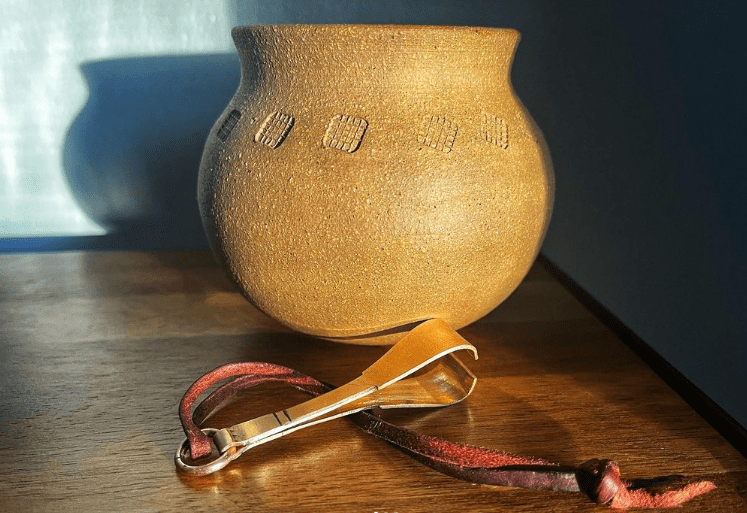
These tweezers are inspired by a find from Dorestad, now in the collection of the Rijksmuseum van Oudheden (Inventory No. WD 760.3.1). These are a typical early medieval grooming tool, and many more similar examples can be seen in the Portable Antiquities-Netherlands database as well. Like the Dorestad example, mine are about 6cm long, and I made them from bronze.
Cup
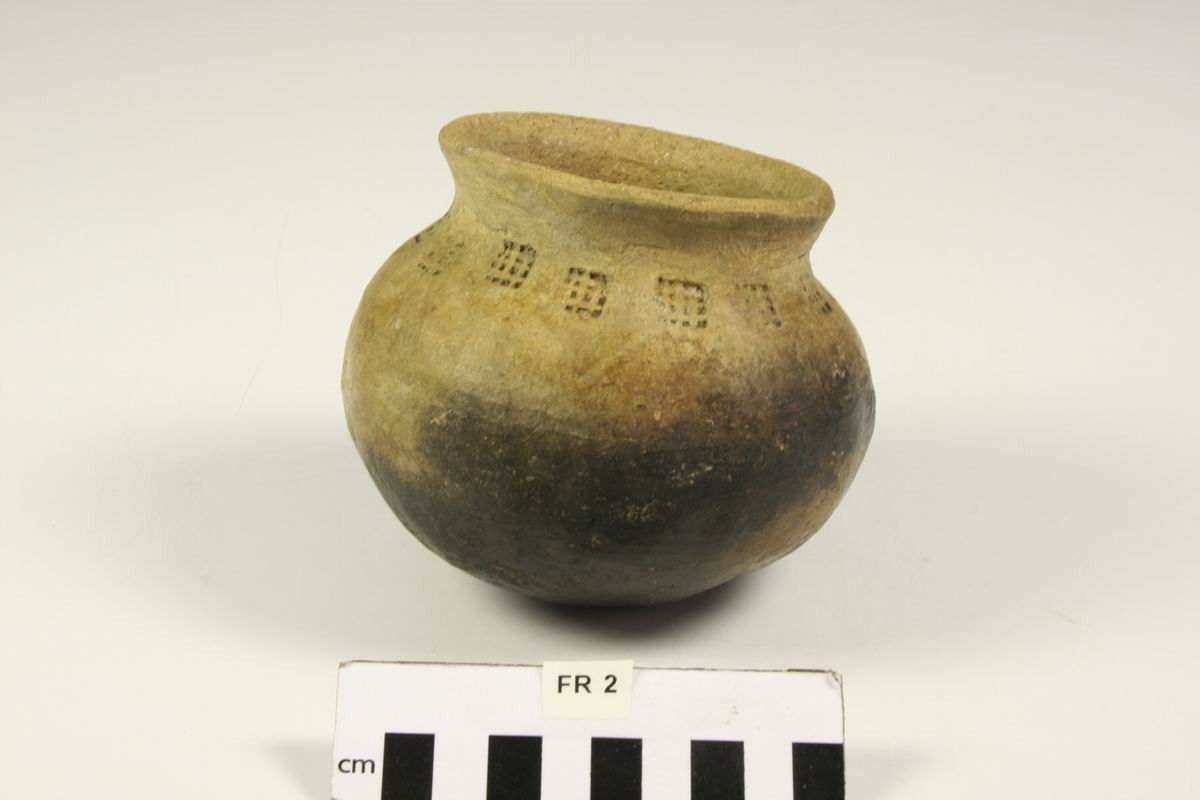
I also wanted a drinking vessel of some sort. Luckily, I’m a potter so I can make whatever I want. The little cup is based on examples of Frisian ball pots decorated with a single row of very simple grid stamps, like these two from the collection of the Rijksmuseum van Oudheden. Both were found in terpen in the province of Groningen; the one on the right was found at Westeremden, the one on the left at Farmsum. They have very round bottoms and an everted rim and fit very comfortably in the hand.

Bone Accessories: Pendant, Knucklebone, and Buckle
Although the Frisian material doesn’t provide nearly the quantity of leather finds that I would have liked, there are many fascinating bone items. I have incorporated three more into my kit: a knucklebone, a pendant, and a second buckle. Animal knucklebones or astragali have been found in the region from Roman times onward and are generally regarded as game pieces. A particular sheep knucklebone found in the Wijnaldum-Tjitsma terp (see find no. 4057) and dated to the Carolingian period has a hole drilled through the middle and seems to have been polished or naturally abraded on one of the flat surfaces. The hole suggests that it was strung on something, so it may have been a good luck charm rather than a gaming piece. I drilled a matching hole in a sheep astragalus and sometimes wear it on a cord underneath my undertunic, or I simply carry it in my pouch.

The decorated disc is less ambiguous and was almost certainly a pendant of some sort. The original was found at Dorestad and is dated 750-900 CE. It is about 1.5” in diameter, and I opted to make mine slightly crooked in imitation of the real thing. If you look closely at the museum example, you can also see that there are two different ring-and-dots; the arms of the cross are done with a double ring, and the outer ring is very faint, while the border is a single ring—I only had one auger small enough so I used the single ring throughout.
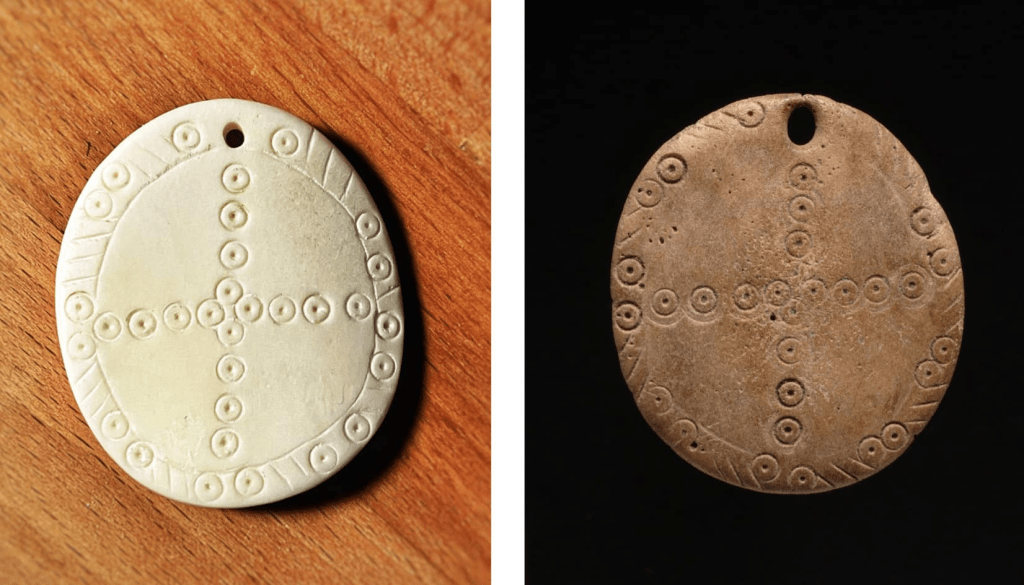
It didn’t seem like there was any obvious residue from a blackening compound in the decoration, but I have used a mixture of soot and beeswax to make similar decorations “pop” on past projects and may add it later on if I can find evidence to support this. I believe there have been some finds of bone combs with tar used to fill the carved decorations, but I have seen nothing to suggest that this was widespread.
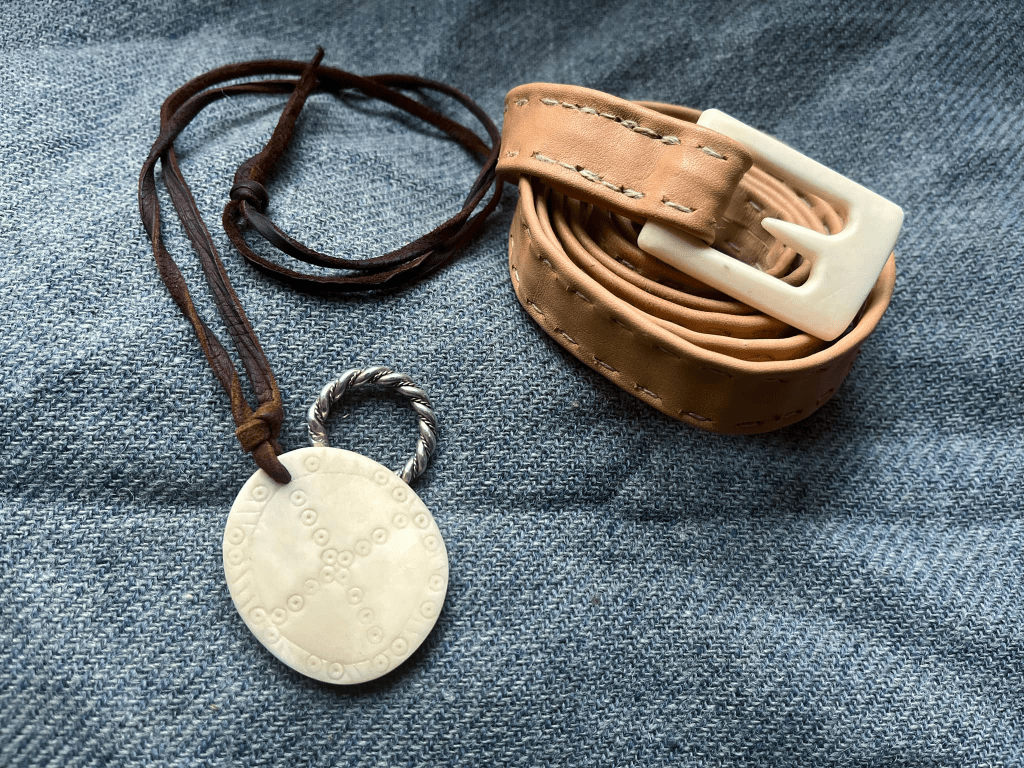
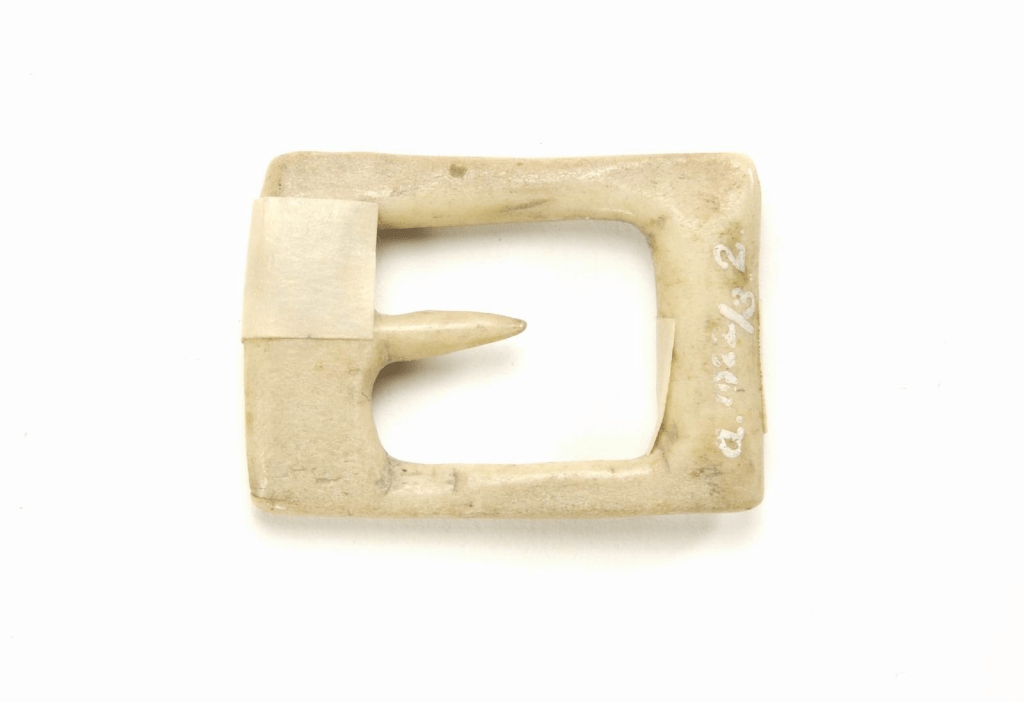
The first belt buckle I made for this kit was a very carefully carved and decorated bone buckle based on one from a terp in Dongjum. I also ran across a much simpler buckle type from a different terp and decided that I would make a replica of it as well and use it as an alternate. This buckle (see below) was found in a terp at Britsum (near Leeuwarden) and dated between 750-900 CE. The strap in the photo above is made from thin calf-skin, doubled over and stitched with waxed linen thread. For the most part, I use this one to hold my Hedeby vest closed on very windy days.
Leather: Purse and Sheathe
The leather items are informed by finds from Haithabu, but these are quite generic examples of commonplace leather items–a plain utility knife sheath, a small rectangular purse, etc. Although the scale, materials, and construction are based on the material from Haithabu, there is nothing about them that is exclusively Danish so I am comfortable including them.
For my knife, I made a very basic back-seamed sheath based on an example from Haithabu (see Item 5 in the line drawing below). It is a mid-weight vegetable-tanned calf (kip) hide with a single whip-stitched seam using waxed linen thread. As tempting as it might be to carry a small utility knife in a heavy leather sheath that is elaborately tooled, the finds from Haithabu do not support this at all. Of 21 sheathes studied by scholar Willy Groenman-van Waateringe, more than half were found to be made of goatskin, while five others were made of calf. None showed any intricate tooling, which makes sense since these thinner weight leathers do not take impressed tooling as easily. The beauty of the sheathes that cover most of the knife handle is that they do not need to be an airtight fit, so this was a very quick project–I wrapped a bit of wet leather around the knife, scored my seam line with a thumbnail, trimmed it and sewed up, then wrapped the knife in some clingfilm and shoved it into the sheath while it dried overnight.
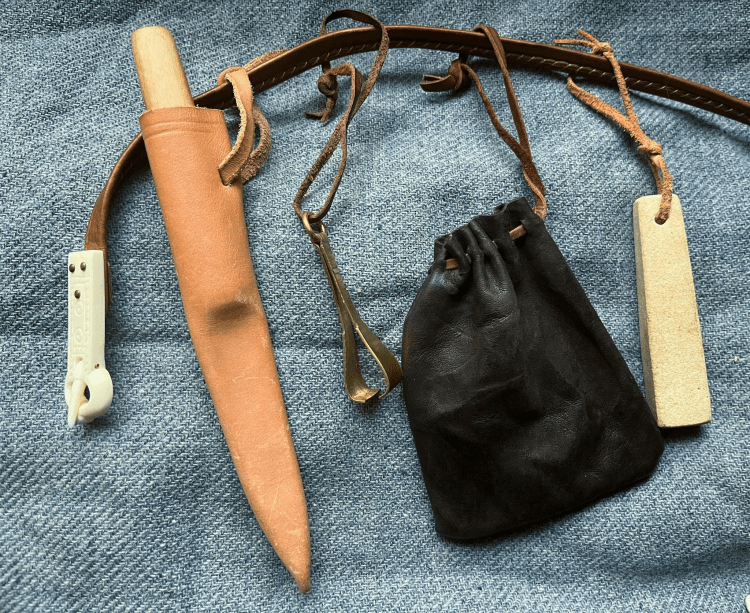

The simple rectangular purse is loosely derived from a Haithabu find (as is the whetstone, which was purchased years ago from a source I have since forgotten). Made of very thin goatskin, the purse seams are whipstitched on the flesh side and the whole thing was then turned right-side-out. It is about the size of my palm, (9cm x 12cm) and is a discreet spot for a drivers license, single car key, and a bank card or a bit of cash, but is also a good place to put a dozen replica coins, a lucky bead, dice, or other small historically accurate items. In a living history context, I am a firm believer in eliminating unnecessary modern intrusions rather than finding “historically-inspired” ways to accommodate my phone.
I hope to take more photos of myself in this ensemble, but for now this will have to do. All told, it certainly feels more like a person’s entire set of possessions rather than just an outfit, and I think this shows what a difference accessories can make.
 farolfvs me fecit
One thought on “9th c. Frisian Kit Updates”