
There are a couple of very small trefoil-shaped stamps shown in the primary source for the Anglian and Saxon examples I work from, and today I decided to take a crack at one of the tiniest, fiddliest ones. The exemplar is shown here at the lower right, from a pot found at Newark in Nottinghamshire, England.
In laying out the design, I had to consider three elements, all of which were very small – the three dots, a central triangle, and the three-lobed outline of the stamp – and determine the most sensible order of operations. Working from a round cross section of antler tine, I started off by boring the three holes to form the dots in each lobe. I decided it would be easier to do that first and then work into the material around them, since if I had left them for last, I would be trying to line up the bow drill in a tiny area with no margin for error. I think I made the right decision.

The three holes determine the rest of the layout – the second step is to carve notches between each of the dots, taking care that they are all the same depth so the die doesn’t end up off-kilter. Continuing to work into the notches, I slowly removed material until the die face had the right silhouette. Then the last step was to carve the lines that form the central triangle. Using the deepest part of each notch to line up my cuts, I simply went from one notch to the next in three straight cuts. I did a bit more cleanup work, taking a bit more material off around each of the three dots – boy am I glad I bored those first!
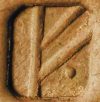
And voila: the finished die and some test impressions. The face of the die is about 6mm across – a bit smaller than a pencil eraser.


Source: Myres, A Corpus of Anglo-Saxon Pottery of the Pagan Period, Vol. 2, Fig. 136.
 farolfvs me fecit