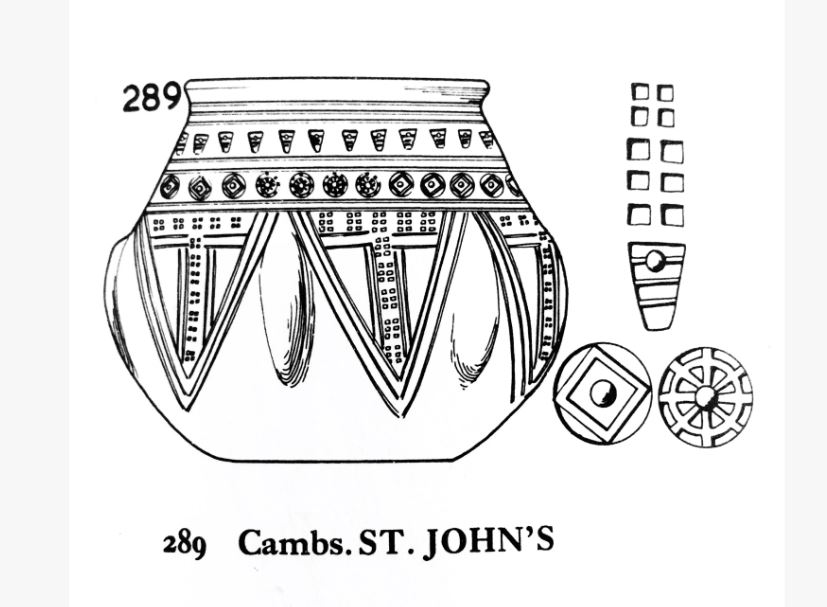
I had the day off work and it was pouring rain outside, so I ended up spending more time than usual in my shop this afternoon. I took the opportunity to tackle a group of five stamps that all appear on one pot from the cemetery at St. Johns in Cambridgeshire. Myres attributes this urn to a potter working in or near Girton, and it likely dates to the middle of the 6th century CE (see Myres, A Corpus of Anglo-Saxon Pottery of the Pagan Period, Vol. 1, p.54).
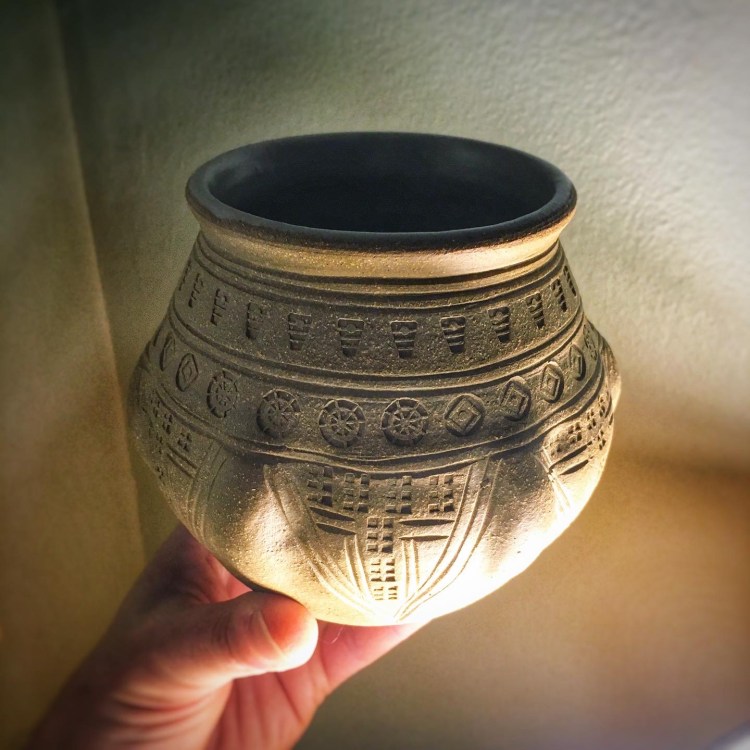
The pot has a fairly complex design made up of horizontal bands of three different stamps – two round, one triangular – separated by incised lines. Below the the shoulder of the pot, oval rounded areas have been pushed out to form bosses and the area between the bosses is decorated with incised lines in the shape of large triangles. Within each triangle, two different gridded stamps (a 2×2 and a 2×3) are arranged in a T-shaped pattern. So for this one, I went through my box of stamps and decided these were all different enough from the ones I have that I would try to replicate all five.
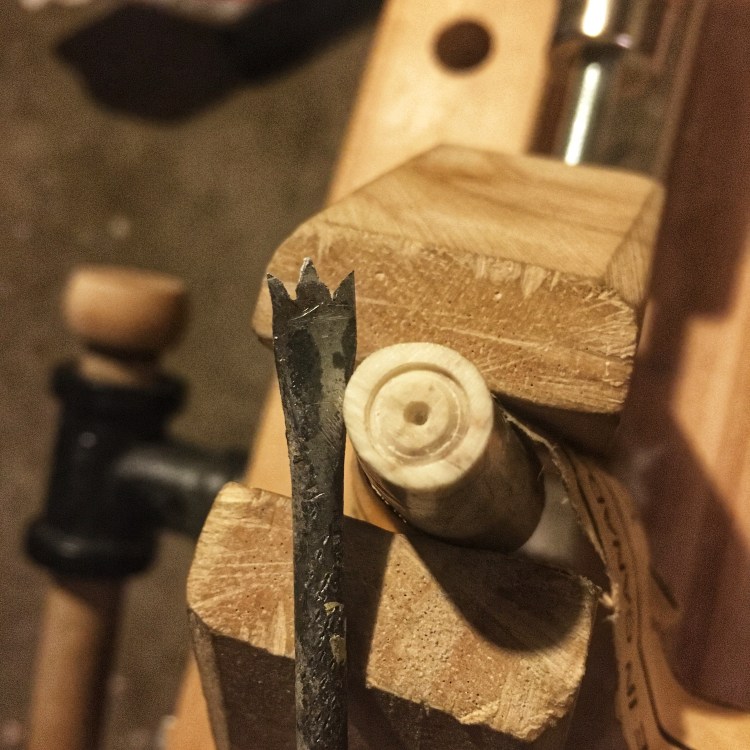
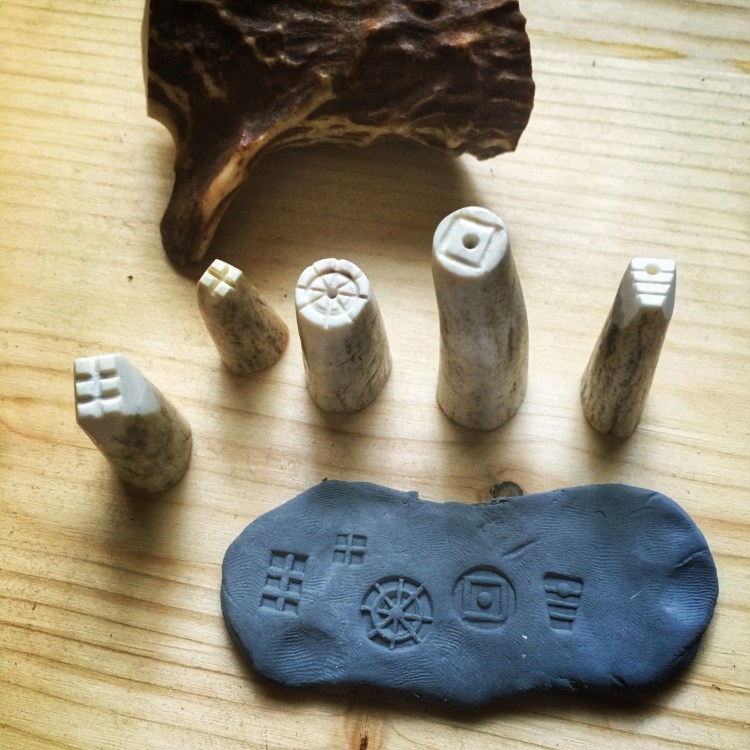
Around the upper part, the potter used a rosette with an inner ring. This design is essentially a ring-and-dot motif that has four lines cut across the face to form the rosette. Starting off, I realized I didn’t have a ring-and-dot auger that was the right diameter, so I had to make one first. Once that was done, I used that to make the center dot and the inner ring. From there, all I had to do was carve the intersecting lines that break the motif up into eight wedges.
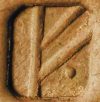
Next up was the other round stamp – this one has a square carved into it and a dot in the center. Using a very sharp blade, I carved the square in, taking care not to blow out at the edges. After that was done, I bored the central hole using a bow drill.
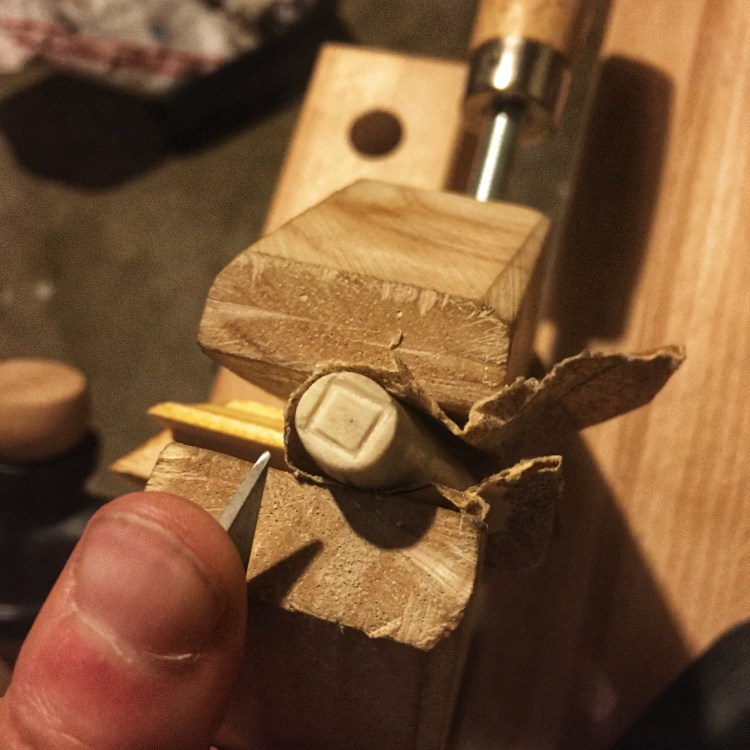
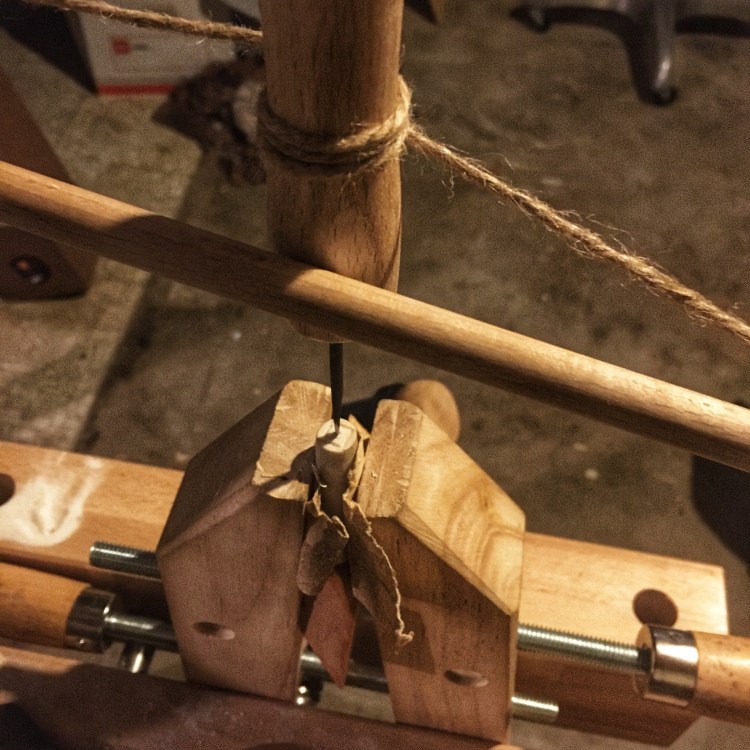
The 2×2 and 2×3 grids were pretty straightforward (literally, just carving the lines across the stamp face), as was the triangular one – though I also used the bow drill to add the small hole at one end. The test impressions came out well, so I’m looking forward to trying these out on an urn this weekend! And just to give you a sense of scale, the largest stamp pictured below is just over 3/8″ in diameter, so this was fairly fiddly work.
And at long last, the finished product: it holds almost 750ml of ale. This one has a modern food-safe glaze on the interior because I will probably sell it to someone who will want to put it in the dishwasher.
Source: Myres, A Corpus of Anglo-Saxon Pottery of the Pagan Period, Vol. 2, Fig. 331.
 farolfvs me fecit