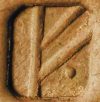


Here’s another case in which a particular pot stamp is distinctive enough to identify a specific potter or workshop. J.N.L. Myres identified this one as the “Planta Pedis” workshop (Latin for the sole of the foot) and while the shape of the stamp is highly simplified compared to the elaborate sandal-clad feet in Pannonian examples from several centuries earlier, it’s still easy to see why. These pots are found in multiple locations around East Anglia (Norfolk), including Rushford, North Elmham, Caistor-by-Norwhich, and Castle Acre – a spread of nearly 40 miles.
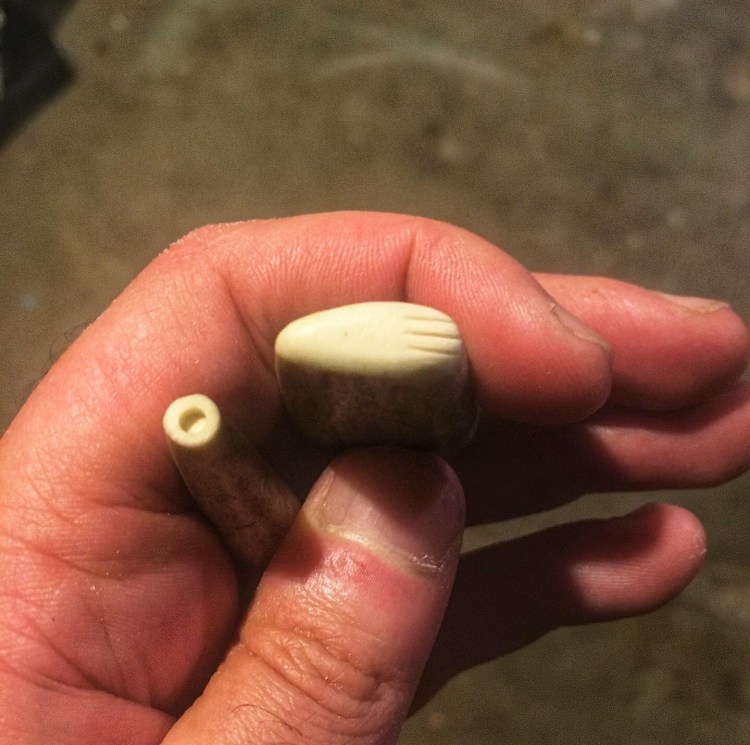
To reproduce both the foot stamp and the small ring that accompanies it on many examples by this potter, I selected two antler tips that had a natural cross-section very close to the final form – one was almost perfectly round, so I was able to saw a flat face and then bore out the center. For the foot shape, I chose a bit of antler that was flatter and more oblong in cross-section. I flattened the face, then beveled the edge to soften the transition, then carved the three lines creating four little “toes” at the wider end of the oval.
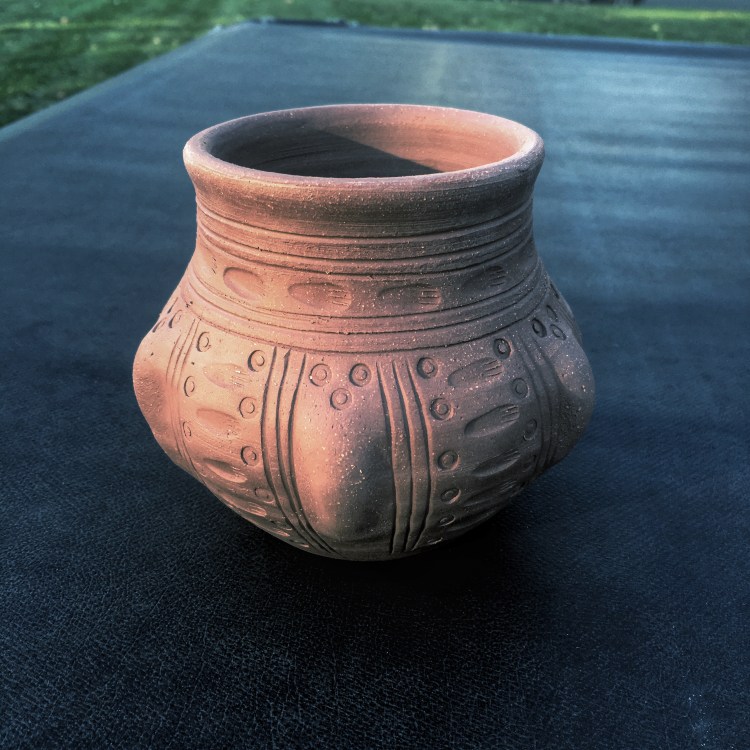
My test pot is loosely based on a vessel from Rushford, and has shoulder bosses, incised lines, and vertical and horizontal rows of stamping.
Source: Myres, A Corpus of Anglo-Saxon Pottery of the Pagan Period, Vol. 2, Fig. 155.
 farolfvs me fecit