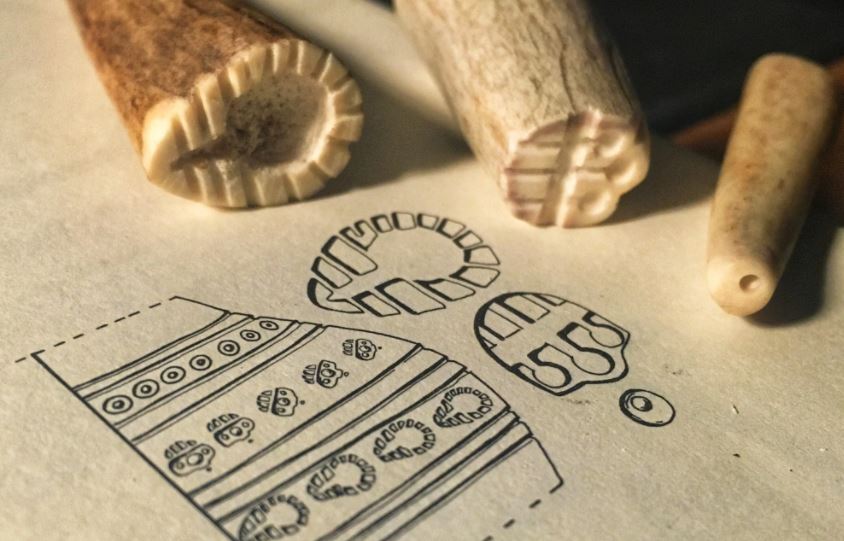
While a lot of the stamps found on British pottery in the Anglian or Saxon style use common, simple motifs like rings, quartered circles, or various shapes divided into grids, there are many that are quite distinctive. Today’s project was a grouping of three stamps based on a pot found at Lackford in Suffolk (just outside of Bury St. Edmunds). These consist of a teardrop-shaped motif, a tiny round stamp with an off-center dot, and a third one that is not easily described – it has three slight lobes at one edge, corresponding to three spoon-shaped carved areas bisected by a perpendicular band. This third one also appears on a pot from Girton, near Cambridge (about 30 miles from Lackford), and the published drawings of the Girton and Lackford stamps are so similar – and the motif so distinctive – that it may have been produced by the same person.

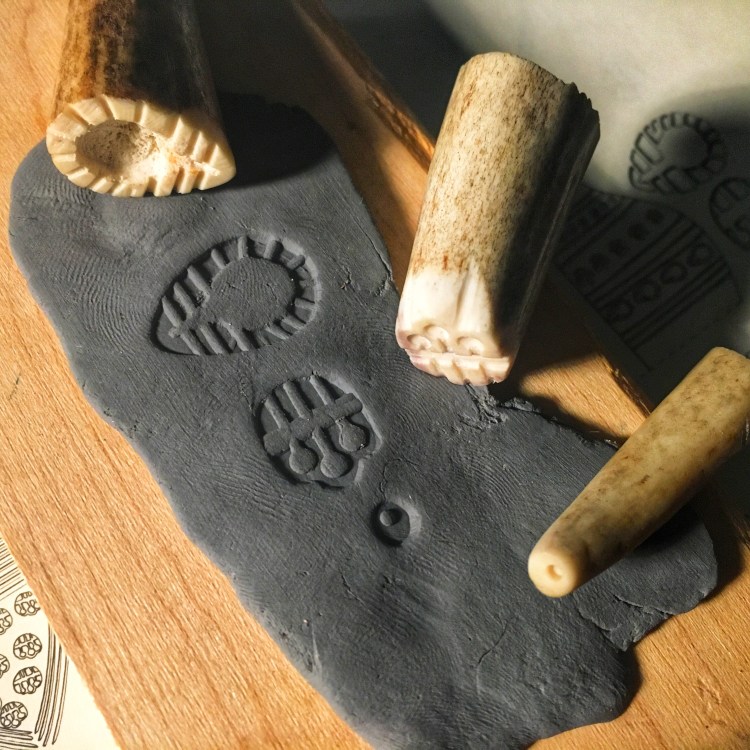
The tiny one with the offset dot was easy enough. For the teardrop-shaped one, I selected an antler tip that was already the appropriate shape in cross-section. The hollowed-out portion in the center corresponds to the porous core of the antler, further fuel for my theory that the original die makers also took this into account – my personal opinion is that the removal of the undesirable spongy core may have dictated the design of some stamps. The third, lobed stamp was a bit tricky; starting with an oblong cross-section of antler, I bored the three holes and carved away the material around them, then carefully carved the three lines to form the “spoon handles” before sawing the perpendicular band.
And here’s the first pot I tested them out on!

Source: Myres, A Corpus of Anglo-Saxon Pottery of the Pagan Period, Vol. 2, Fig. 149.
 farolfvs me fecit