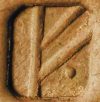

I was intrigued when I saw this Frankish pot from the Rijksmuseum van Oudheden go by in the museum database, since the decorative stamping was unusually minimalist compared to many others. This shape is called “biconic” in English, the form is essentially two conical portions, although if you are searching in databases in other languages, the form is often called something that would translate as “bent wall pot” or “bend pot” (it’s Knickwandtopf in German, knikpot in Dutch) and is extremely common in this period – the Rijksmuseum van Oudheden collection includes 150 biconic pots of various sizes and proportions that were found in Rhenen, where the exemplar was excavated.
While the overall form is quite common, the museum did not seem to have any others that were decorated with this motif, which the catalogue entry describes as “little Thor’s Hammers” (although there isn’t really any context to tell us whether that was the potter’s intent). The T-shape is stamped just four times, evenly spaced around the outside on the upper half of the form. It was made using the same stamp die twice in a perpendicular arrangement.


The first step in reproducing a historical stamp is to deduce the shape from the impression. In looking at a photograph, I have to rely on the way the stamp catches light (or dirt, sometimes) to understand which portions are positive or negative space and which parts of the impression are deepest. Some stamps have a flat face and make an impression of uniform depth, while others have a more rounded impression, indicating that the face of the stamp may be beveled. From there, I can determine the layout of the cuts and make them with a knife blade, saw, or file, and bore out the center if needed.
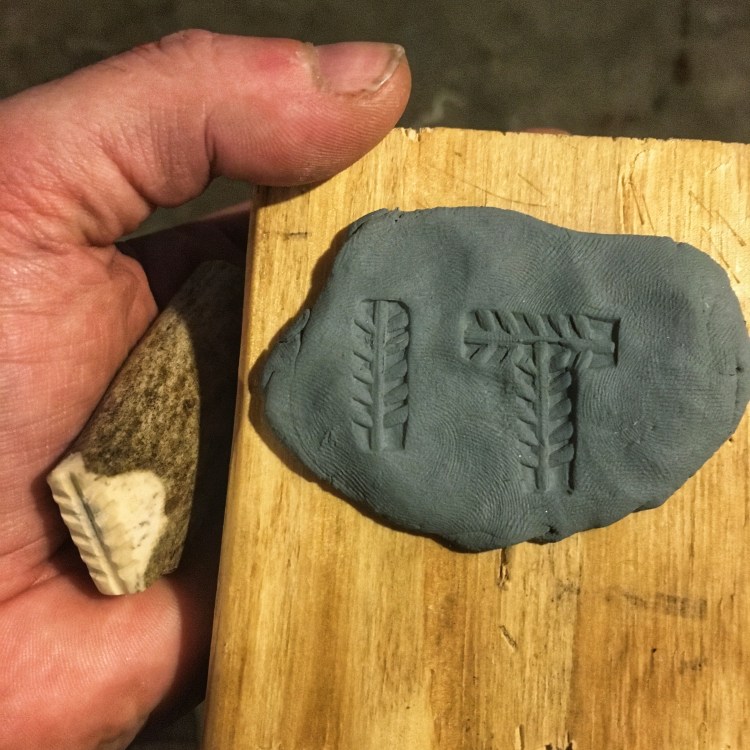
Replicating this stamp die was a good exercise in reading the impression to understand what sort of positive is needed to produce that negative. In looking at the shadow in the museum’s photo, I can see that the long central ridge sits lower in the impression than the short angled cuts, which seem to be a consistent height and end much closer to the surface. This indicates that the long edges of the stamp are likely beveled to slope away from the central ridge. I started with a piece of antler that was already fairly close to final shape in cross-section, so I only had to carve away a bit of material to get it into a long, rounded rectangle. From there, I made the long central cut, beveled the edges away from it, and then made my side cuts. I tested the impression on a bit of kneadable eraser and made some minor adjustments until I was satisfied.
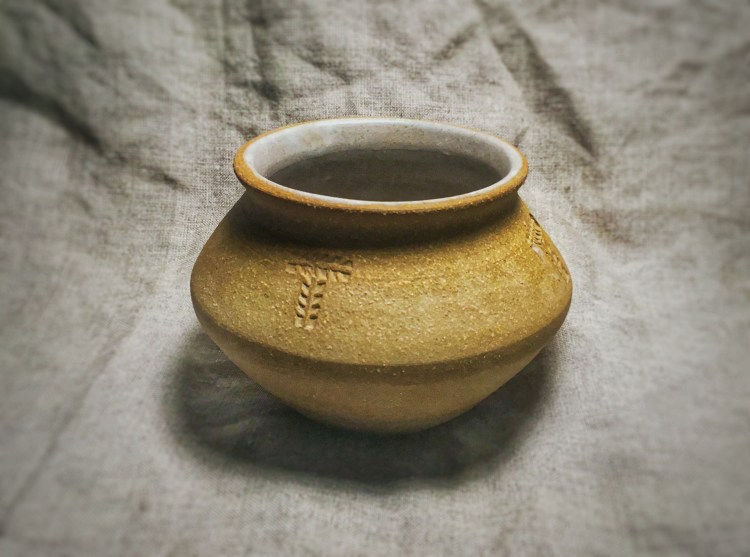
Here’s a test pot after firing. I added a glazed liner because all the reenactors who buy my pots seem to want theirs to be food-safe, but the original pot is totally unglazed.
 farolfvs me fecit