
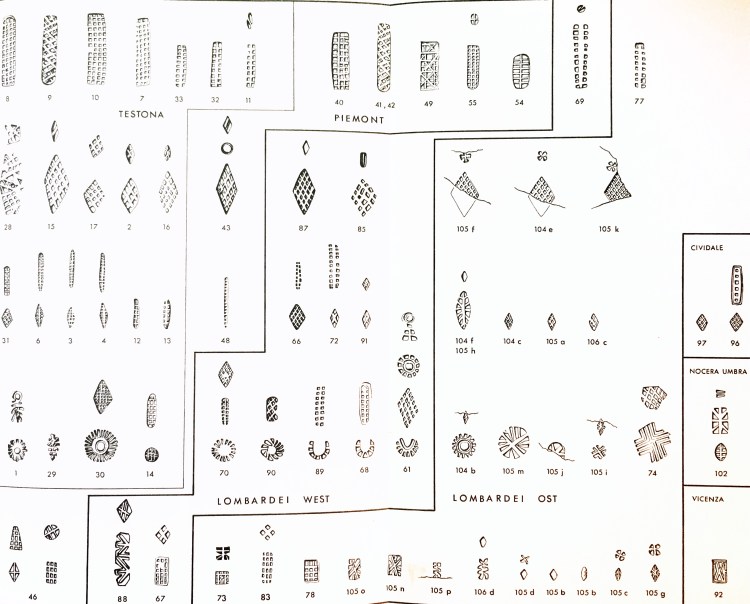
As a reenactor, I mostly portray a late 6th/early 7th century CE Langobard from what is now northern Italy. In my “normal” life, I started making pottery again in 2014 after a long hiatus, and was often puttering away making teapots and mugs on a kickwheel in the garage. More recently, while researching Langobard clothing and accessories, I started running across examples of associated pottery as well, and was intrigued by the stamped decoration, so I decided to make a few cups and jugs to add to my camp site at historical events. That sort of spiraled – the real turning point was when I got a copy of Otto von Hessen’s 1968 book on Langobard pottery found in Italy. It has images of tons of jugs, flasks, beakers, but at the back of the book, I found a large fold-out sheet with scale drawings of dozens and dozens of stamp motifs, grouped by region and keyed to the photographs of the pots in the book (see below).
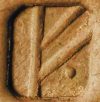
I was hooked, and the next thing I knew, I was driving around thinking to myself, “gee, what if I just…replicate all the documented stamp dies used on these Langobard pots?” Over the span of several months, I reconstructed about twenty stamps, covering most of the general motifs represented in von Hessen’s diagram (some are extremely similar; I did not try to copy each of the variations of the diamond/lozenge grid stamps). In the process, I had to learn how the stamp dies would have been made. To do that, I needed to look at continental and insular Saxon finds of tools, since that is a contemporary, closely related culture with a similar pottery tradition and there have actually been finds of horn and antler tools in Britain and Frisia that match stamped pottery motifs (you can read more about that here).

As many research rabbit holes tend to do, this one ended up a lot deeper than I had intended, as I got interested in the parallels and overlaps between the Langobardic and the Anglian/Saxon pottery styles and the ways that the Frankish pottery style continued some earlier Roman traditions into the early Medieval period, like the use of roulette tools (stay tuned for that little sidetrack at some point soon).
This blog will be a place to post to chronicle what has turned out to be an ongoing experimental archaeology project that shows no sign of ending, as I continue to learn more about different types of stamp motifs and how to reproduce them using historically accurate bone and antlerworking methods, as well as building up my arsenal of period tools – the goal is to be able to understand the pottery decoration process of the Migration Era and Early Medieval period in the Saxon, Langobardic, Frankish, and other related styles from the ground up. Stay tuned!
 farolfvs me fecit